Draft Strategy From The 1.02 In 2026 Fantasy Football: Bijan Robinson Is A Great Consolation Prize
Chris Allen runs down a mock draft from the 1.02 in Draft Champion, proposing the draft strategy from the coveted second spot in 2026 fantasy football drafts.
“Close enough.” Those were famous last words from yours truly.
I think I already mentioned it, but my family and I moved houses in late May. Of course, a new house means fresh furniture to construct and orient for all to look at and nod in approval when they come by.
So, I’m assembling shelves over the weekend and, to drive the brackets into the studs, had a laser level set to ensure the boards would lay flat. The air bubble was more or less in the middle, and I noted its “approximation” to the center as I went to make my mark. I forgot that my wife, who was within earshot, didn’t ask for shelves that were nearly level. That’s not the same thing.
Neither is sliding just one draft slot to the right. Sure, the 1.02 is still an early position. You’re guaranteed to open with a high-end skill player, too. But as the rounds progress, you’ll see enough subtle differences to consider it a unique starting spot.

Join Our Newsletter
Trusted by 400,000+ fantasy football players. Get access to Fantasy Life's free award winning newsletter and tools, all in one step.
By registering or logging in, you agree to our Terms of Use and Privacy Policy.
Fantasy Football Draft Tips From The 1.02
It’s Not Just Which QB You Draft … But When
Every year there’s an offseason debate as to which QB draft strategy is the best.
Early QB will set you free. Sure, as long as you take Josh Allen.
Mid-round QBs are where it’s at. Absolutely. Perennial top-10 options like Dak Prescott and Brock Purdy live in that range.
Late-round QB never fails! All hail JJ Zachariason. And I’m positive I can scrounge a QB1 week out of Malik Willis and C.J. Stroud.
Anyway, before taking up the banner of whatever approach we want to champion, let’s look at the environment that every passer is working through in this era of football.
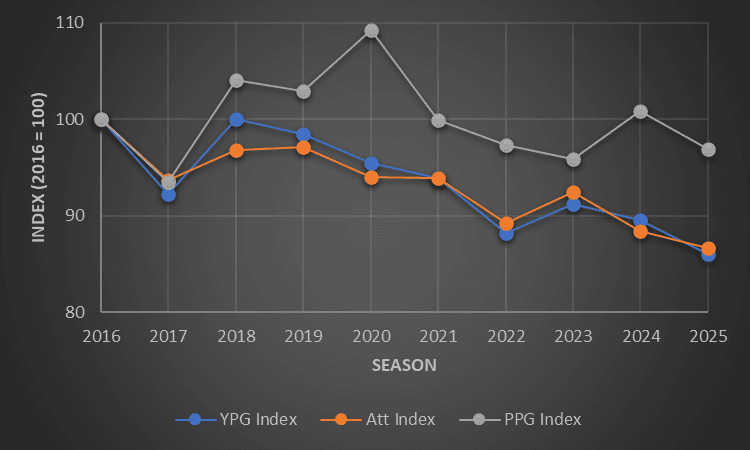
Blerd Tip: Converting a data series into an index allows you to scale the values and draw conclusions from the overall trend. For example, while we can’t see exactly how many yards per game QBs were throwing for in 2021 (237.1), it was less than the year prior.
The increased attention toward defensive schemes and their playcallers has put the clamps on opposing offenses. Passing volume and production have been on a steady downward trend since 2018. However, fantasy scoring doesn’t have the same rate of decline.
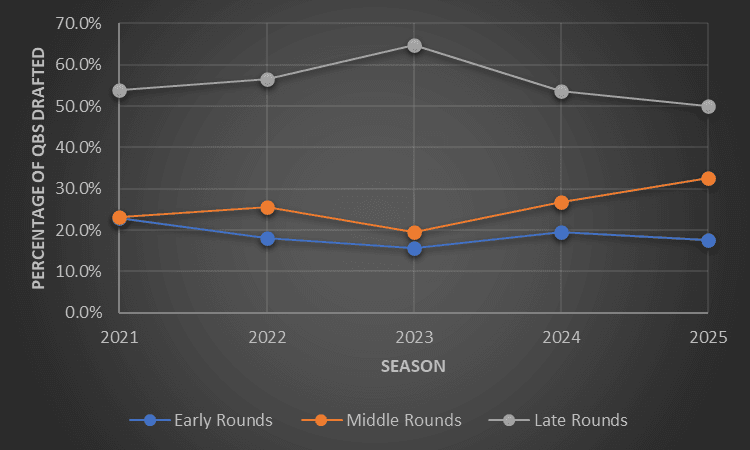
Credit where it’s due. As point totals crept towards their lowest in a decade, drafters bucked the notion of waiting on their QB1. We know what profiles to hoard. And with 16 passers accruing at least 200 rushing yards (the most in a single season of all time), fantasy gamers understood the value of a mobile triggerman, pushing more QBs into the middle rounds.
The takeaway? You’re not the only one trying to get Josh Allen. However, as I laid out in my approach to the 1.01, the case for Buffalo’s MVP isn’t only based on past production. But what we can project moving forward.

Both Allen and Lamar Jackson are the only QBs with projections of +3,500 passing yards and +500 rushing. Jalen Hurts is coming in just shy of both thresholds. Drake Maye falls short on the mobility side. But the combination is where you get your league-winning upside. The result that justifies an early-round pick. So, even as you start to see those names creep up toward the top of the “Available to Draft” list, think more about what they offer relative to the other options before adding them to your squad.
Go Big or Go Home At TE
Let’s start here.
I walked through the importance of routes last year and highlighted it as a building block for generating fantasy points. You can’t score if you’re not on the field. But for TEs it’s different, as playcallers can ask them to act as a blocker or receiver. In either case, Rich Hribar is (always) right regarding the TE1. However, I wanted to expand on the thought to reframe how we should be approaching the position as a whole.
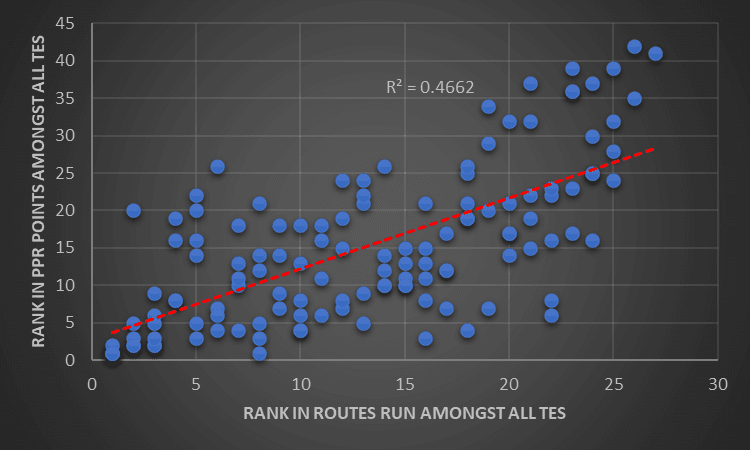
In a nutshell, if a team treats you like a WR (i.e., has you run more routes), then you’ll (likely) produce like one. But the extreme cases, like Brock Bowers and Trey McBride, don’t speak for the entire position. We need to bound the problem with best- and worst-case scenarios if we’re trying to find answers to this “onesie” position early.
- 2025 Season: WR4 (TE1), WR16 (TE2), WR23 (TE3)
- 2024 Season: WR8, WR9, WR15
- 2023 Season: WR15, WR16, WR23
- 2022 Season: WR5, WR20, WR22
- 2021 Season: WR5, WR8, WR26
If we’re going to call pass-catching TEs “WRs with a TE designation,” let’s compare them as such. McBride’s 2025 campaign would’ve had him as the WR4. Kyle Pitts (!) and Travis Kelce were top-24 options. And having a minimum finish as a WR2 holds for all but one top-3 TE over the last five seasons. So, if we use our projections as a threshold for what the top 24 will look like by December (Emeka Egbuka, 211.4 PPR points), only three TEs meet the criteria for an early-round investment.

Slim pickings. But you’ll see more come off the board in the middle and late rounds. However, let’s see if any of the route data (along with any efficiency metrics) from last season would help us highlight any value targets after the elite options are gone.
- Sam LaPorta (Consensus ADP: 80.9): Seventh in routes per team dropback rate before season-ending injury; one of five TEs with a YPRR of 2.0 or higher
- Dallas Goedert (Consensus ADP: 112.9): Ranked ninth in route rate; one fewer pass-catching option in the Eagles’ offense with A.J. Brown trade
- Dalton Kincaid (Consensus ADP: 114.8): 71% route rate in 2024 before getting hurt; second in TPRR when healthy in 2025
The adage in years past has been to find the TE that has a chance to fall into the end zone. Touchdowns fuel the ranks like any other position. But first, they need to find the field. So, finding the players who are regular contributors to their team’s passing game will help you find the right guys to draft once you get into the latter stages of roster building.
Now, let’s draft!
Who do you Select at the 1.02 in 2026 Fantasy Football Drafts?
For reference, here’s the format I chose:
- 12 teams
- 0.5 PPR
- 1 QB, 2 RBs, 3 WRs, 1 TE, 1 FLEX, 1 K, 1 DST
You’re On the Clock!
Even before your turn, you’ll notice the discrepancy in firing from the two-hole. Like your lead-off person, you’ve considered the player worthy of your sacred first-round pick. But hopefully you have a backup. Because, like what’s happened to me in many simulated mocks, your No. 2 choice will become your top option.
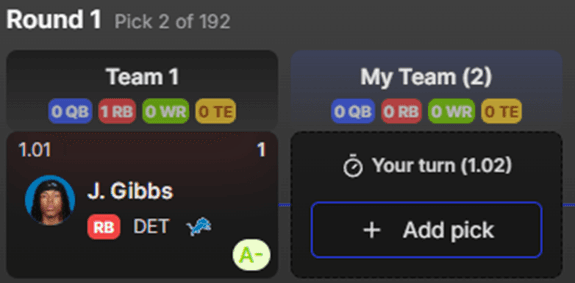
Our Draft Champion tool is many things: useful, predictive, and resourceful. But it’s also cruel. I know I said Jahmyr Gibbs should go at the 1.01. However, I wanted my pick at second overall to be easy, too. But the more I looked at it, the less I viewed Bijan Robinson as a consolation prize.
- Rushing Success Rate (2023-2025): 48.5% (Robinson), 46.7% (Gibbs)
- Forced Missed Tackle Rate: 25.7%, 24.2%
- Yards per Route Run: 1.45, 1.45
Since both entered the league in ’23, Robinson has matched or outperformed Gibbs in multiple metrics. Without a doubt, Sonic shines as the more explosive runner. And he’s been lauded for his receiving skill set. But Robinson has averaged over a yard more after the catch per reception than the Lions’ RB1 (9.6 vs 8.3).
And I know what you’re thinking. Gibbs has the better offensive environment. Fair! But in their three seasons as pros, when the Lions have ranked in the top half in every offensive metric and the Falcons … have not, Gibbs has outscored Robinson just once (2024). In other words, I won’t hesitate to click on Robinson if he “falls” to me at the 1.02.
The Rest of the Early Rounds
Two things to consider when foraging for your next five picks. First, remember your league settings. You’ll be so focused on which specific players are and aren’t still available that which positions you might need to prioritize may become a distant memory. Two, plan a few rounds ahead. I’ll give you an example.

The Draft Assistant is flooding my mind with receivers, rushers, ranks and stats. Having to sort between them is bad enough. And I haven’t even considered QB or TE. In any case, if I refer back to my roster requirements, the number of choices dwindles.
- WRs with R2-3 ADP: DeVonta Smith (Proj: 202 FPTs), George Pickens (213.4), Chris Olave (193.9)
- WRs with R4-5 ADP: Davante Adams (173.7), Terry McLaurin (180.4), Ladd McConkey (180)
A balanced open (2RB-2WR) would’ve made sense if four starters at the core positions were in the league settings. But I need at least one more WR every week. And the minimum drop-off before my next set of picks is nearly a point per game. The opportunity cost is a solid RB2. However, if I can find a rusher that at least projects to outscore the WRs in the same range, I can mitigate the risk of missing out on multiple RB2s.
However, if I can find a rusher that at least projects to outscore the WRs in the same range, I can mitigate the risk of missing out on multiple RB2s.
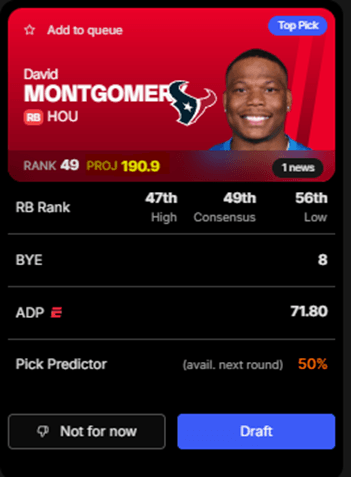
Judging by our projections, the tier of high-end RB2s cuts off after David Montgomery at RB20. Anyway, his addition provides flexibility in where we can look on the wrap. However, without any QB or TE sticking out from a value standpoint, all of my early-round picks went to the positions that will do the heavy lifting during the season.
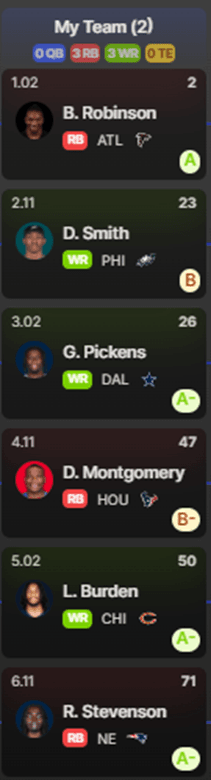
Mid-Round Pitfalls
I’ve discussed this before, but the middle rounds should be for filling gaps in your roster. And identifying them is half the battle. Take my current squad, for example. At a glance, you can pick off a few things I need to address sooner rather than later.
- A QB1 would be nice.
- I guess TE is deep, but let’s get that sorted.
- Bench depth at RB or WR would be solid.
The first two bullets are my bigger concerns. I took multiple swings at RB and WR early. If I still have questions about who’s going to be starting for me each week, I’ve got bigger problems. So, let’s at least look at the onesie positions. Even better, I wonder if the process for finding value at TE I detailed earlier can apply here.
- Route Rate: 73%, 16th
- Target Share: 22%, 4th
- Targets per Route Run: 24%, 1st
Harold Fannin was not just the Browns’ TE1, but also their top receiver in his rookie debut. He outearned Jerry Jeudy despite missing most of Week 17 and had many wondering where David Njoku would be playing in ’26 and beyond. Going back to 2015, across six seasons as a playcaller, Todd Monken has had two TEs return top-10 results (Mark Andrews – 2024, Cam Brate – 2016). Fannin’s short-area agility will work well with Monken as he tries to simplify the offense in his first season with Cleveland.
- 7.02 – Harold Fannin, TE
- 8.11 – Michael Pittman, WR
- 9.02 – Dak Prescott, QB
- 10.11 – Tyrone Tracy, RB
- 11.02 – Xavier Worthy, WR
- 12.11 – Isiah Pacheco, RB
Building a Championship Roster
Let’s see where we stand after trudging through the rest of the draft.

What?!?
But I’m the one writing the mock. I’m supposed to win every time. Well, not exactly. Let’s take a look under the hood and see where things went awry.
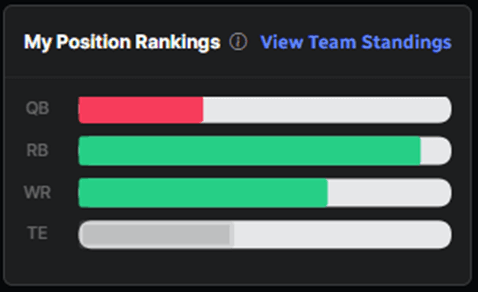
Two things here. First, I mentioned earlier that I wanted WRs to be my strength, as I need more on a weekly basis. But my value at the position declined as I plugged the holes at QB and TE. Instead, I wound up flush with RB power. Truthfully, in a 0.5 PPR league, it’s not a bad position to be in as targets don’t carry as much weight.
Looking back on it now, swapping out Rhamondre Stevenson for another receiver or dipping my toes into the onesie waters would’ve put me on a better path. Yes, I’d move “depth at RB” up my priority list when evaluating my roster at the 6/7 turn. But then, I could maintain an advantage at my other positions. I went back and replaced Stevenson with Tyler Warren, played out the draft in a similar fashion, and made some progress with the result.
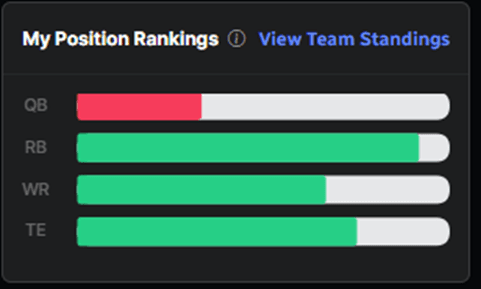
A minor change that still gave me a powerful roster with a strong projected outcome. But, more importantly, the process to get there is what will keep you in the driver’s seat for the playoffs.

Unlock Our Tools!
Stop hitting the paywall. FL+ gives you access to our expert rankings, projections, mock draft simulator, start/sit, and all the tools you need – all personalized to your league.
Players Mentioned in this Article
 JoshAllenQQBBUF
- PPG
- 23.2
- Proj
- 365.5
 MalikWillisQBMIA
- PPG
- 12.3
- Proj
- 256.9
 C.J.StroudQBHOU
- PPG
- 14.1
- Proj
- 257.0
 BrockBowersQTELV
Published Updated