Draft Strategy From The 1.03 In 2026 Fantasy Football: Build Around Ja'Marr Chase
Chris Allen walks through multiple ways to approach your 2026 fantasy football drafts from the 1.03 draft slot.
I’m not too proud to admit that my kids have duped me. In a sense, I’m an easy mark. They used to catch me like I am now. Hunched over my keyboard, either staring at a spreadsheet or a blank doc with a blinking cursor. They’ll ask a seemingly innocuous question, and I’ll give a quick go-ahead without a second thought. It’s only when I hear their mother investigating how our children were allowed to engage in hooliganism (her words, not mine) that I realize I should’ve paused before acting.
Admittedly, it’s a rookie mistake. But so is assuming that you know how the first two picks of your draft will play out. The 1.03 in fantasy football drafts almost feels like the leadoff or two-hole spots. We’re so used to seeing other mocks go the same way that the pattern becomes gospel. However, by waiting, gathering more information and thinking about other possibilities, we can better navigate a draft from a strong starting position.

Join Our Newsletter
Trusted by 400,000+ fantasy football players. Get access to Fantasy Life's free award winning newsletter and tools, all in one step.
By registering or logging in, you agree to our Terms of Use and Privacy Policy.
Fantasy Draft Tips From the 1.03 In 2026
(League) Size Matters
Speaking of making assumptions, here’s one I find myself doing when discussing fantasy football ADP: every league is a 12-teamer. No disrespect to the smaller or larger groups of gamers. It’s the league size I play in most often.
However, this is part of why I stick to phases of the draft and archetypes of players to draft. Because how many drafters you’re competing against will shift the ADP landscape.
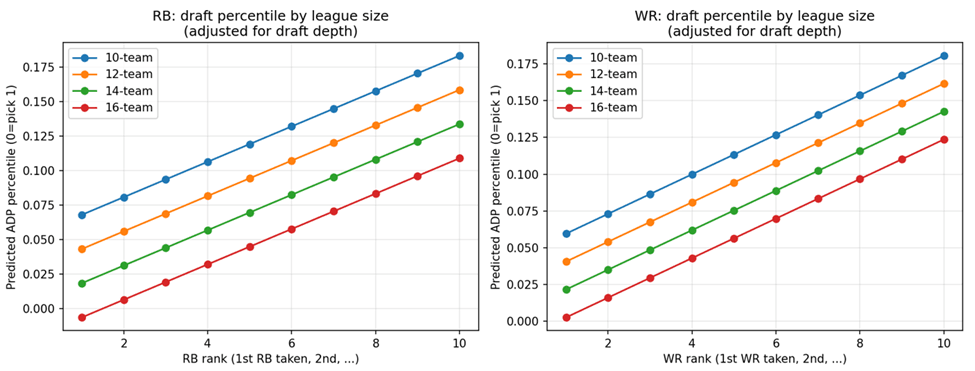
Blerd Tip: Percentile essentially means how much of something relative to the other values expressed as a percent. For our purposes, 0% means the first pick of the draft and 0.1 or 10% means you’re that far into the draft depending on league size.
I snagged about 100 redraft leagues between 2024 and 2025 with varying league sizes to see how ADPs differed by team count. No surprise, but adding more drafters pulled a player’s price farther forward in the draft. WRs carried the larger cost hike as the fight for WR2s and WR3s only becomes fiercer as the rounds continue.
The simple solution? Adjust ADP tables to account for format. Expect your targets to come off the board earlier in larger leagues or to have some time to wait on other players in smaller leagues. By keeping that in mind, you can better plan for when to attack certain positions as the picks come off the board.
Now, let’s draft!
For reference, here’s the format I chose:
- 12 teams
- PPR
- 1QB, 2RBs, 2WRs, 1TE, 1FLEX, 1K, 1DST, 6 Bench
You’re On the Clock At 1.03!
Like I mentioned in the intro, missing out on Jahmyr Gibbs at the 1.01 or Bijan Robinson (1.02) isn’t a given. You might run across a Bengals fan (me) or someone who dislikes the Lions or Falcons. In either case, there’s a universe that exists where you have a top WR or RB to click. If that happens, take the gift offered to you.
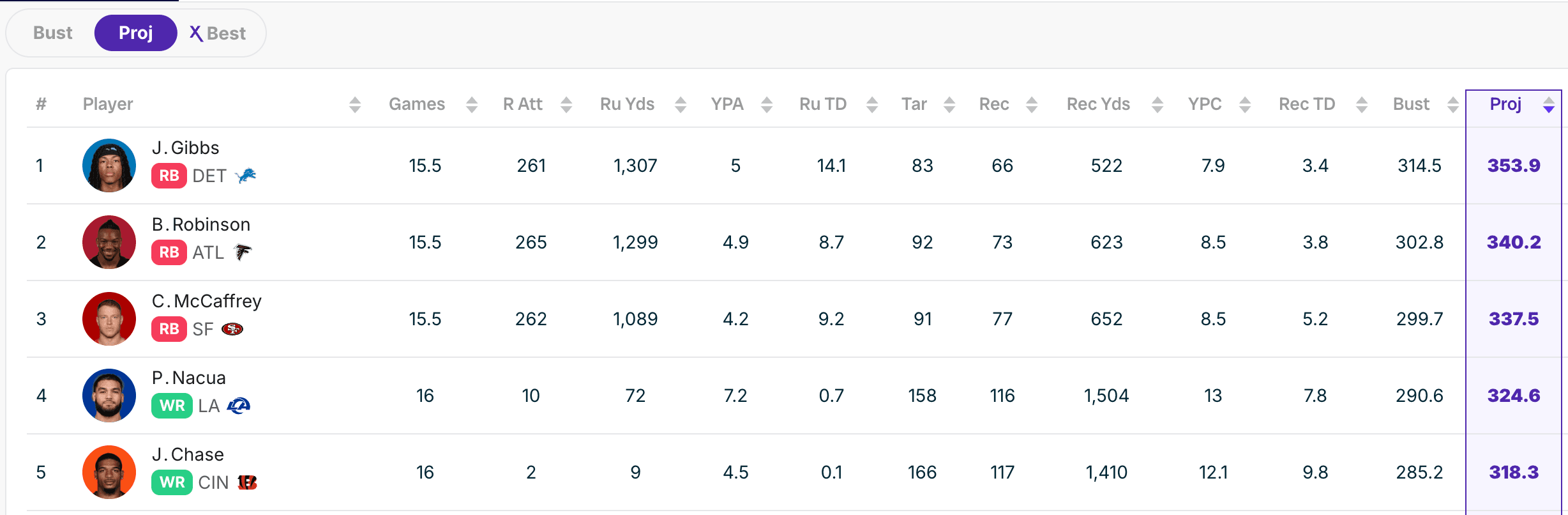
The projected touch count for either rusher (Gibbs – 344, Robinson – 357) dwarfs the target volume for either of the top two WRs that’d be in consideration. Plus, the drop-off to second-round RBs is more than worth thinking through the opportunity cost:
- Josh Jacobs (projections): 26.8 (ADP), 298 (touches), 237.0 (PPR points)
- Chase Brown: 27.4, 283, 255.7
But let’s look at the other potential reality. Gibbs and Robinson are gone. The timer starts. Spotlight is on you. However, with a few runs through our Draft Champion tool, you’ll see these faces more often than not.
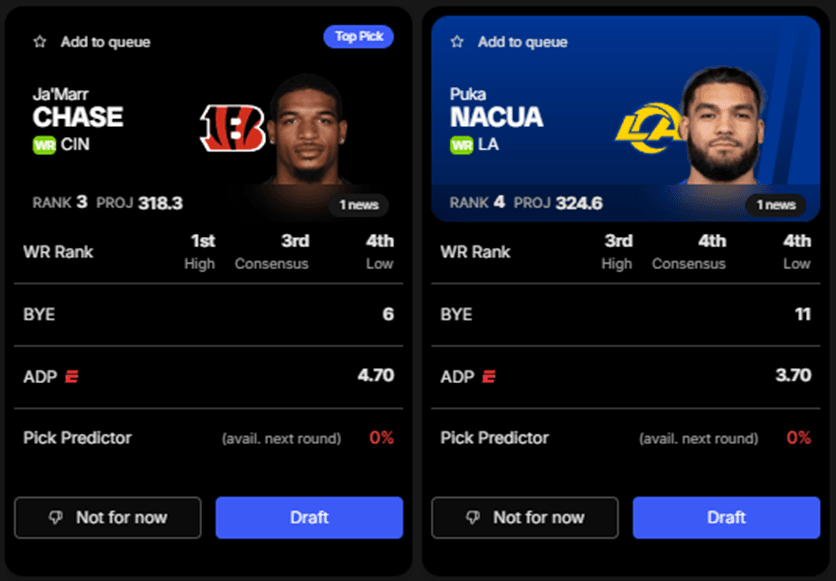
If you scroll up a bit, you’ll see that our projections show Puka Nacua ahead of Ja’Marr Chase in points scored. And yet, the two-time First Team All-Pro receiver has the nod from the Draft Assistant. I’ll venture a couple of guesses as to why.
- Target Share (2021-2025 amongst all WRs, min. 75% route rate): 25.9%, 4th (out of 34 qualifiers)
- YAC per Rec: 5.8, 1st
- YPRR: 2.26, 6th
First, Chase’s track record, from both an opportunity and results standpoint, has cemented him as a first-round WR. And contextualizing his volume gives the former LSU Tiger a slight edge over the Rams' WR1. When the Bengals are in scoring position, Chase’s target share has been at 27.6% since ’23. Nacua sits at 20.3% as LA uses multiple receivers and TEs in that area of the field. And that’s not the only schematic advantage for Chase.
- Pass Rate (since 2023): 64.1% (Cincinnati), 56.8% (Los Angeles)
- Red-Zone Pass Rate: 60.5%, 52.1%
- Passing Plays per Game: 40.0, 35.8
The Bengals have ranked inside the top five in pass rate over expectation every season Joe Burrow and HC Zac Taylor have been with the team. Chase not only benefits from the play style, but also amplifies it as he operates from every pre-snap alignment and absorbs looks at each level of the field. It’s no wonder Chase has more games with a PPR point total above 25.0 (13 to 9). His residence at the intersection of talent and opportunity should be the tie-breaker needed to make him the WR1 in ’26.
The Rest of the Early Rounds From The 1.03
All right. You’ve got Ja’Marr Chase. Now what?
Well, there are two paths ahead. One, we lean into our strength at receiver and pick our spots at every other position. Or, you right the ship and grab an RB. Both have their merits. However, using this year’s market pricing and projections as a proxy, the decline in talent at rusher is more severe in the first two rounds.
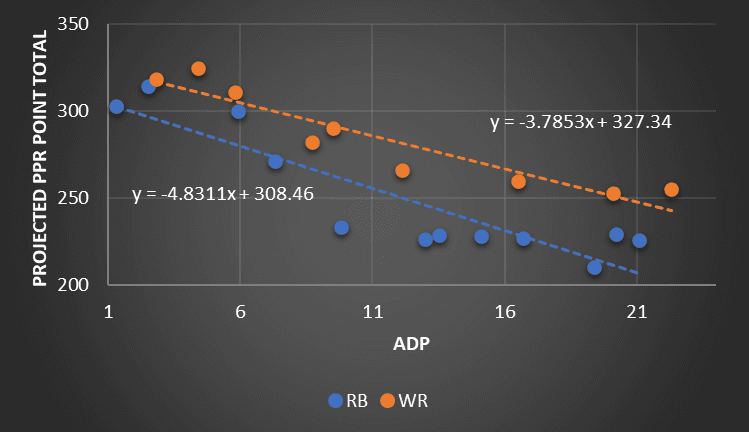
Blerd Tip: Two things to note here. First, it’s one season of data and doesn’t fully define early-round behavior. I’d need more data to stand on this initial conclusion. Second, the first number in the equation is the slope or rate of change. The bigger the value, the faster a line is going up or down.
Personally, I’d at least glance at the runners available. But that’s the joy of using a simulator. We can explore either universe. I know I’ve already tipped my hand on the open I’d prefer, but I’ll let you qualitatively compare these two rosters after the 2/3 turn.
Multiverse 1:
Multiverse 2:
Truth be told, these were the top options at their positions for each of my picks. But anyway, ignore the grades by the Draft Champion. I argue with them frequently. Focus on the profiles of the players taken on either build.
Derrick Henry and Nico Collins are a part of high-end or ascending offenses with unquestioned roles. A.J. Brown should take the WR1 spot in New England, but the Patriots added other pass catchers over the offseason or are developing them from last year. And then there’s Breece Hall and the Jets. I don’t need to tell you that 30 PPR points separate these two teams (828.8 vs 799.8). We can gauge the divergence from the names alone.
In a similar situation, it’s hard not to feel like you’re behind. But you can tilt the draft back in your favor.
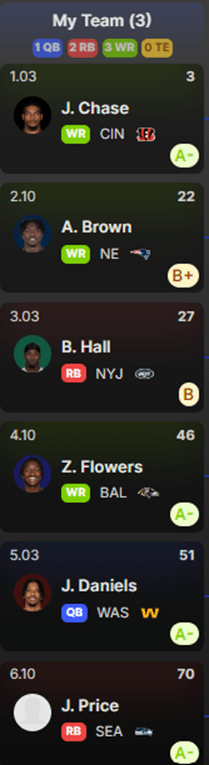
Switching our attention to other positions, specifically a onesie (i.e., QB or TE), gives you some leverage. Your opponents focused on adding to their WR/RB stable. Good for them! But you zagged. Now, QB and WR are your weekly weapons. Admittedly, tacking on Jadarian Price (projected for the 25th-most touches of any RB) was an option to fill out my RB2 spot. But a fourth WR to place in your FLEX, and close out any need for the position for the next couple of picks, would also work.
Mid-Round Pitfalls From The 1.03
Let’s go back to that first team. The one that had so much promise through the first three rounds. I built out an amazing core by the seventh round.
Other than bye weeks, I wouldn’t need to start another WR. However, if we use a similar process for evaluating the squad as we head into the middle rounds, two glaring gaps appear: QB1 and TE1. And, unsurprisingly, the Draft Assistant is nudging me in one of those directions.
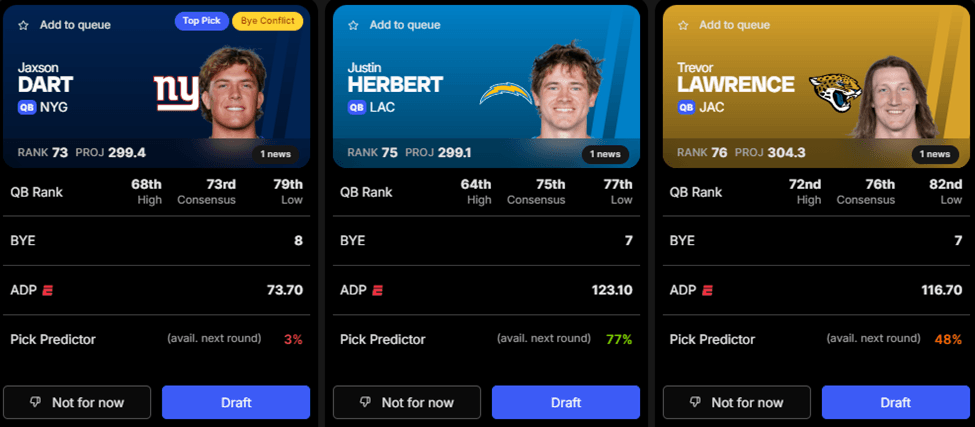
Granted, it’s only the seventh round, but 11 QBs are already off the board. You might check the list of viable weekly starters and feel the pressure mount. There’s a chance you could miss out on all three by the time the draft gets back to you in the 8th round. However, let’s talk about arbitrage plays.
- ADP: 73.7 (Dart), 98.0 (Prescott), 102.1 (Purdy), 116.7 (Lawrence), 123.1 (Herbert)
- Proj. Point Totals: 299.4, 303.4, 301.5, 304.3, 299.1
I compared the projected point totals for a few of the free-agent QBs. In short, there’s no rush for me to scoop one up now. I can forgo drafting Jaxson Dart with his seventh-round price only to find at least three other passers with higher ceilings later. In doing so, I can add to other positions or address my need at TE without further limiting my strength at QB.
Building a Championship Roster In Fantasy Football From The 1.03
Let’s try the exercise from before one more time. From starting rosters alone, let’s see how they compare.
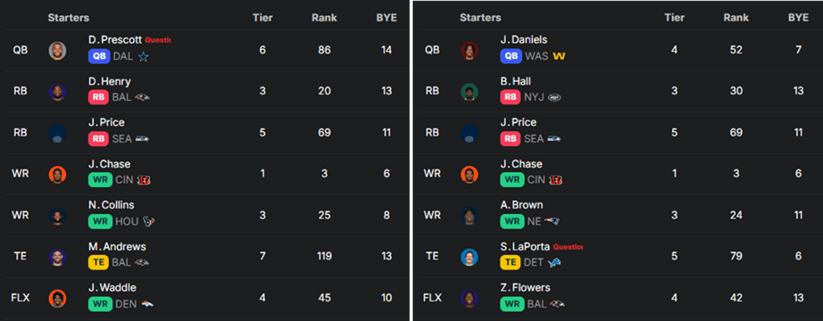
At first glance, Team 2 closed the gap. Attacking QB early, along with getting Sam LaPorta to kick off the middle rounds, buttressed the drop in WR output. Meanwhile, Team 1, at least on paper, sacrificed the potential for a weekly top-5 scorer at QB for a stronger foundation at RB and WR. That’s why pivoting to other positions was the right strategy, as there’s no “catching up” in drafts. As a result, Team 2 was able to pull ahead everywhere else.
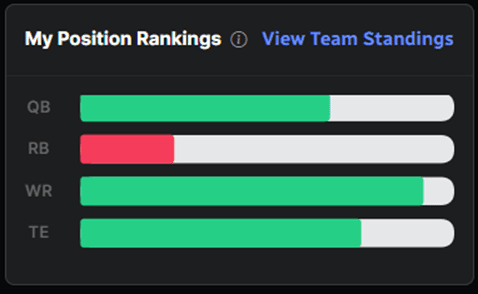
Simply put, the “keep your head on a swivel” adage extends to fantasy drafts. We have multiple positions to fill each week. Some carry a higher priority because we require more of them to start. However, if your draft position or style limits your ability to amass talent where you want, shifting to the other designations can still net you a roster bound for the playoffs.
Join Our Newsletter
Trusted by 400,000+ fantasy football players. Get access to Fantasy Life's free award winning newsletter and tools, all in one step.
By registering or logging in, you agree to our Terms of Use and Privacy Policy.
Players Mentioned in this Article







Published Updated